The Disconnect and a Reset
THERE’S ALWAYS BEEN A SIGNIFICANT distance between the art market and the practice of painting. I’m referring of course to those who make paintings and those who sell paintings. During the last thirty or forty years this disconnect has become much more acute – the distance greater than ever. The most significant development is the influence the art market now exerts on cash-strapped public galleries.
Lax regulation has meant that the art market is subject to accusations of OCG (Organised Crime Group) involvement which seems to have increased exponentially due to the opacity of the crypto market which has eased money laundering, augmented by the toxicity of celebrity culture. Collectively this creates a ‘climate’ of mutual advantage and interdependence which drives and defines the narrative spun by mainstream media; celebrity equates with success. The tyranny of ambition, false ambition and a race to the bottom.
Meanwhile, hidden from media attention and questionable patronage, a vibrant subculture is emerging, one that proffers different values and aspirations. Symptomatic of this reset is a ‘community of practice’ and central to this network is the belief that painting is a discourse, not simply an activity, nor a commodity. Which is not something neither shared or understood by those previously sceptical of painting’s viability or cogency. I’m referring to artists who’ve decided belatedly and conveniently to exploit painting as a commodity because it creates a lucrative ‘earner’. Let’s not confuse the influence of the market with any lasting historical significance, let alone a set of values.
The greater the artist. The greater the doubt. Perfect confidence is granted to the less talented as
a consolation prize
I’ve always been sceptical of the way in which the name Duchamp was bandied around in the 90s to lend the YBAs some questionable intellectual legitimacy. I worked at Goldsmiths during that time and I can state with some confidence that several of the aforementioned had

Flower Arranging 6
no idea who Duchamp was, let alone what his legacy might actually entail. In hindsight, the overriding influence wasn’t Duchamp, it was Thatcher.
On one memorable occasion, during a group crit at Goldsmiths College, a student raised the issue of class and was immediately shut down by the tutor. It’s also now widely understood that the collector/dealer Charles Saatchi had a disproportionate influence in establishing the YBAs as a putative ‘movement’.
It’s interesting to note that no mention was made at that time of conceptual art’s precursor, Fluxus, the disruptive anti-capitalist, Marxist-inspired movement, one of the aims of which was to de-commodify the art object. There’s a great similarity in the marketing strategy between the YBAs and K-Pop – as both seem to bear the traits of what’s referred to as ‘synthetic culture’.
The new job of art is to sit on the wall and get more expensive
I recently asked friends whether they visited Tate or the Hayward and the majority said, “Seldom, if ever” – a clear disconnect. Both are experiencing dwindling attendance figures, a situation that some would argue is self-inflicted due in large part to the sanctimonious

and didactic curating. Why would anyone pay good money to be hectored about the obvious injustices of racism, misogyny, cultural imperialism, colonialism, slavery or whatever? Killing people is wrong. I get it.
The perpetual box-ticking in order to curry favour with funding bodies and general virtue signalling reached fever pitch a few years ago when a muchanticipated show of Philip Guston at Tate was almost cancelled but eventually postponed. A senior curator at Tate who complained publicly at the time eventually took ‘voluntary’ redundancy. Tate’s explanation for the postponement was so opaque as to be unintelligible and downright disingenuous. The truth of the matter was that the Tate management didn’t trust the British public to distinguish racist art from art about racism.
In art there is no progress, only functions of intensity
One reviewer, a few years ago, accused Tate of ‘wokeish drivel’ but on another occasion the same journalist suggested that anyone who thought a recent Tate show either narcissistic, adolescent, cynical or banal, should “…find yourself another cultural interest because art is not for you.” Which is not only intolerant, but offensive. This authoritarian-sounding certainty is the epitome of the disconnect. The cracks are beginning to show.
He suggested that the work was raw and honest; that’s what we're supposed to think.
Flower Arranging 7
I’ve always thought that art should expand the mind – not shrink it. This is critical orthodoxy. The days when art could shock are long gone (if they ever really existed). ‘Raw’ is an aspect of rhetoric and style; a matter of choice. It should be remembered that these paintings are luxury items which employ a well-established language and, like so much expensive art, are conceived to enhance the homes of a wealthy and ignorant elite whilst making them wealthier.
Furthermore, the suggestion that art is an ‘interest’ epitomises the disconnect. Art maybe an interest for some, but not for me – I don’t find art remotely interesting – I don’t even like or dislike art. I simply don’t think like that and I refuse to identify as an artist – I’m a painter. Painting lends my existence something approaching meaning. It defines who I think I am. Existence is anything but interesting. Art historians and journalists should stick to what they imagine they know best – the past.
What strip mining is to nature the art market has become to culture
Talking of which, it feels like history repeating itself; emergent or transformative ‘moments’ materialise primarily as marginal, subcultural tendencies – aspirations or beliefs that invariably represent a rejection of ‘dominant culture’. This time around it’s fragmentation rather than regime change.
Can it be that the artist who paints flowers starts at a disadvantage? Almost certainly
The disconnect is becoming increasingly evident in curating and publishing particularly concerning issues of legacy. In an otherwise passable exhibition of Turner, his legacy was reduced to a soppy ‘pigeon shit’ 1 seascape by Damien Hirst, a dreary gestural daub by Maggi Hambling and a surprisingly indifferent Bridget Riley. Of greater concern is the misunderstanding, not to say misrepresentation, of Samuel Palmer’s extraordinary legacy. In a scholarly tome the author suggests that, amongst others, the inheritors of his legacy
is the Brotherhood of Ruralists, a bunch of second-rate illustrators, one of whom was a convicted paedophile. The ignorance of current British painting, particularly landscape painting is quite breathtaking. There’s an overwhelming number of fine landscape painters currently working in the UK and abroad who owe an enormous debt to Palmer. Which raises another area of contention symptomatic of the disconnect. That’s the longstanding inability of writers, curators and even some painters who seem unable to differentiate painting from illustration. (I’ve addressed this chestnut elsewhere.2 )
There is virtue in virtuosity, especially today, when it protects us from the tedious spectacle of ineptitude
A much-needed but ignored reset has already begun. However, it’s been evident in just one publication for more than 20 years – the excellent Turps Banana, a magazine written predominantly by painters about painting.
This reset is already apparent in a flourishing subculture which is the province of practicing painters, people who are utterly invisible to mainstream media, painters whose existence and reputations are created by peer group engagement, social media, credible and prestigious competitions like the John Moores Painting Prize and the Contemporary British Painters’Prize. . I speak as one who exists in this ‘eco-system’. It’s smarter, better informed and embraces diversity quite instinctively, without inducement.
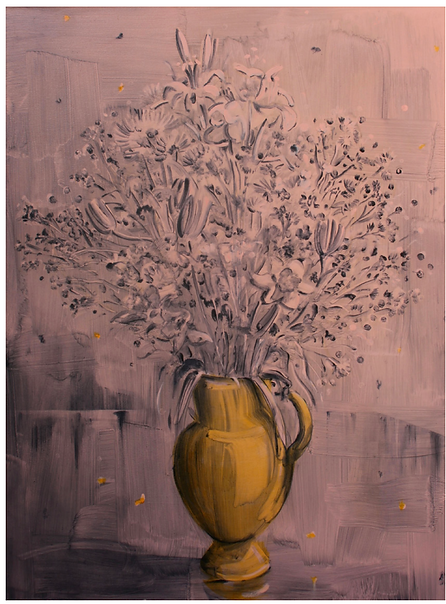
Yellow Vase
Also flourishing in this subculture are many of humanity’s finer traits which are profoundly lacking from the art market’s lexicon: generosity, curiosity, knowledge, doubt, application, intention and skill. Yes, skill. But reviewers still bandy around obsolete and now meaningless terms like ‘raw’ when justifying the casual or the incompetent in the mistaken belief that it’s authentic. That was then, this is now.
Works of art… do not force meanings on their audience; meaning emerges, adds up, unfolds from their imagined centres… takes one through the process of discovering meaning
The established metrics that define notions of success are profoundly problematic. Postconceptual painting as a discourse is a celebrity-free zone. A space in which the painter and the viewer find their own meaning or meanings. This involves an acknowledgement of ‘core’ values that are driving a fresh approach to thinking about painting. A significant element of this community are the accessible and entertaining films of Rob Dunt. For those of you not familiar with his films, Rob has a YouTube channel, ArtTop10. He’s also a very accomplished painter.
What does one prefer? An art that struggles to change the social contract, but fails? Or one that seeks to please and amuse, and succeeds?
Meanwhile, somewhere else, there’s a lot to celebrate. I’m referring to a vibrant, curious, generous, questioning subculture that’s embracing painting as a discourse rather than an activity, let alone a commodity. This is evident in projects like the Contemporary British Painters, Turps and the John Moores Painting Prize. In fact, one vital but seldom acknowledged aspect of the legacy of conceptual art is the emergence of post-conceptual painting. What does this amount to? The recognition that painting is probably the most exquisite form of conceptual visual art – ever. A fundamental reset.
It’s significant that almost none of the ‘successful’ big money, celebrity painters have ever exhibited in either the John Moores Painting Prize3 or the Contemporary British Painters’ Prize. Is that possibly because their dealers generally discourage it?4 Social media being what it is, word might get out that they’d not made the cut and subsequently dent their prices.
At the core of this disconnect is the tiresome and false dichotomy spun by journalists

Red Flower Painting
and ‘middle-brow’ academics since the 70s, that painting and conceptualism are locked in some irreconcilable and unspecified opposition. This absurd fallacy still lingers in the mindset of curators at public galleries like Tate and tutors at what were once art schools. There is no dichotomy, only a disconnect.
Edgar Degas said, Painting is easy when you don’t know how, but very difficult when you do.
1. Ironically, during RA Varnishing Day of 1832, Turner on seeing the impasto blobs of white on Constable’s painting of Hadleigh Castle, described it as ‘pigeon shit’.
2. Dumb & Dumber; Painting and Illustration. Graham Crowley.
3. There’s one conspicuous exception. Peter Doig, who won first prize at the 1993 John Moores Painting Prize with Blotter, an absolutely stunning painting.
4. The Tyranny of Ambition. Graham Crowley. Highlanes Gallery, Drogheda.
All eight quotations are credited to the late Robert Hughes who was arguably the last art critic to make a significant and coherent contribution to the discourse. Journalists and reviewers are often credited with being critics. They’re not.
In 1993, Robert Hughes published The Culture of Complaint, a polemic that tracked the emergence of political correctness and cancel culture – the foundations of ‘identity’ art. Hughes could discern and articulate tendencies with an insight and understanding beyond the reach of reviewers.